Ops
Operational Data
Connect inventory, orders, purchases, production, service, customer, and finance records.
Connect ERP with websites, CRM, ecommerce, inventory, accounting, vendor portals, customer portals, dashboards, and operational workflows.
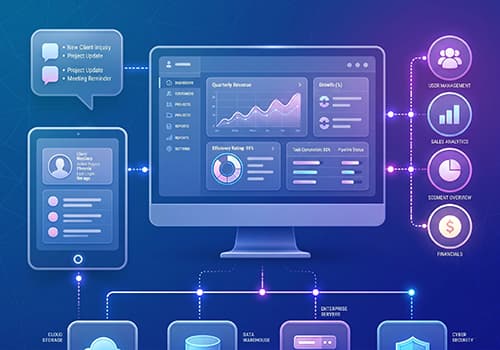
ERP integration connects the operational backbone of a business with the digital systems around it. AMR Softec plans ERP integrations for orders, inventory, customers, invoices, purchase data, production status, service requests, portals, dashboards, and reporting.
Ops
Connect inventory, orders, purchases, production, service, customer, and finance records.
Portal
Link ERP data with vendor portals, customer portals, dealer portals, and internal dashboards.
Control
Plan role-based data access, sync history, exception handling, and approval workflows.
Problem to Platform
We identify the constraints holding a website back, then rebuild the system around performance, search visibility, content operations, and qualified buyer journeys.
Manual workflow drag
Service diagnostic graphic
-35%
Signal
The Challenges
Automated operating flow
Service diagnostic graphic
+68%
Signal
The Solutions
Integration System
Each integration is planned around data ownership, access control, sync rules, reporting, error handling, and long-term maintainability.

ERP
Connect ERP modules with websites, CRM, portals, ecommerce, dashboards, and business systems.

Inventory
Move stock levels, order status, product data, purchase records, and fulfillment updates.

Portals
Connect customer, vendor, dealer, or employee portals with useful ERP records.

Finance
Connect invoices, payments, credit notes, tax fields, and accounting workflows with ERP.

Reports
Create dashboards from ERP and connected system data for management visibility.
Security
Use permissions, logs, validation, and controlled API access for sensitive ERP records.
ERP Workflows
ERP integration helps operational records move through sales, finance, portals, ecommerce, and reporting workflows.
Tools
ERP, ecommerce, inventory modules, portals.
Data flow
Sync products, stock, orders, fulfillment status, purchase data, and warehouse updates.
Teams and customers see more reliable operational information.
Tools
CRM, ERP, sales pipelines, customer records.
Data flow
Move customers, quotes, orders, account status, and service context between sales and operations.
Sales and operations stop working from separate versions of the truth.
Tools
ERP finance modules, accounting software, payment gateways.
Data flow
Sync invoices, payment status, tax data, credit notes, and reporting fields.
Finance reporting becomes cleaner and less manual.
Tools
Customer portals, vendor portals, dealer portals, ERP APIs.
Data flow
Show approved ERP records to external users through secure portal workflows.
Self-service experiences reduce support load and improve transparency.
ERP Approach
ERP integration needs clear module ownership, access rules, field mapping, sync timing, and exception handling.
Why AMR Softec
We connect ERP with sales, finance, portals, ecommerce, inventory, and reporting through maintainable architecture.

AMR Softec maps the business process, data ownership, statuses, and handoffs before connecting software.
Why AMR Softec
We connect ERP with sales, finance, portals, ecommerce, inventory, and reporting through maintainable architecture.
AMR Softec maps the business process, data ownership, statuses, and handoffs before connecting software.
SEO and GEO Focus
The page explains ERP integration with operational use cases, data flows, systems, and business outcomes.

Search System
FAQ
Concise answers for performance, SEO, architecture, and delivery planning.
Yes. ERP can connect with customer portals, vendor portals, dealer portals, ecommerce websites, internal dashboards, and custom web applications.
Common data includes customers, orders, products, inventory, invoices, payments, purchase records, production status, service requests, and reporting fields.
Yes. CRM and ERP can share customer, quote, order, invoice, service, and account status data.
Yes. ERP integrations are often best delivered in phases, starting with the highest-value workflow.
Yes. We can work with custom ERP systems if API, database, export, or integration access is available.
It can include role-based access, protected credentials, validation, logs, restricted API endpoints, and audit trails.